

LD-logo-hvitt

A NEW AND
PROVEN METHOD
TO FIGHT SEA LICE

TURNING SEA LICE BEHAVIOR INTO A POWERFUL DEFENCE STRATEGY

Sea lice pose one of the greatest challenges to salmon aquaculture, causing skin lesions, stress, reduced growth, higher disease susceptibility, and mortality in farmed Atlantic salmon. In Norway and globally, infestations drive massive economic losses through treatment costs, lost biomass, downgraded fish quality, and stricter regulations to protect wild salmon stocks.

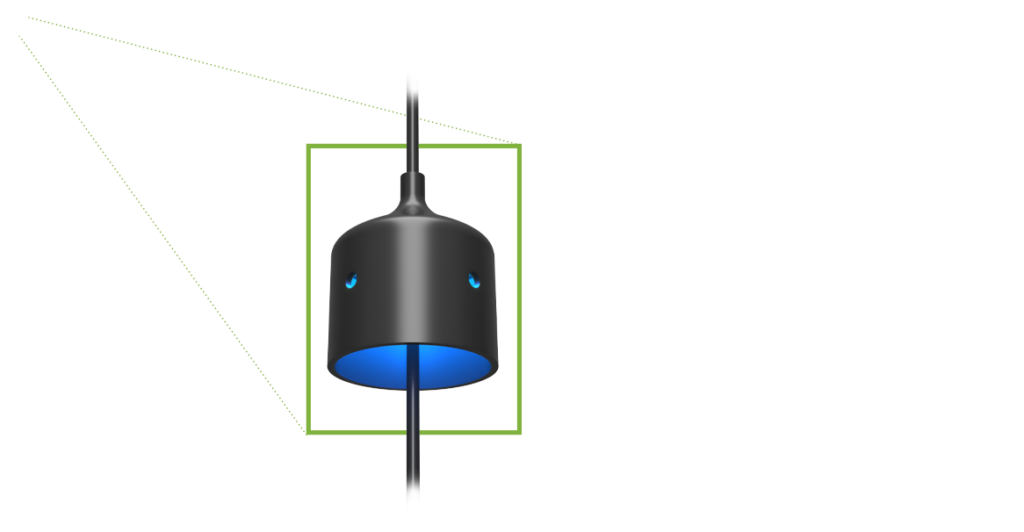
LiceDefence offers a new, proven preventive solution: an innovative trap-based system forming a dense grid barrier around pens. Specific light wavelengths and electromagnetic fields attract free-swimming copepodids before they enter, capturing them in traps where trace chlorine, generated safely from seawater via electrolysis, eliminates lice while preventing fouling. The localized chlorine dilutes harmlessly outside the trap, ensuring no impact on seawater quality.

ATTRACT

Specific wavelengths of light and electromagnetic fields attract free-swimming sea lice copepodids before they can enter the pen.

ELIMINATE

A small amount of chlorine is generated from seawater directly inside the trap through electrolysis, effectively eliminating trapped sea lice.

SELF CLEANING

The trace chlorine produced within the trap serves a dual role: it effectively kills trapped sea lice while inhibiting fouling, ensuring the system requires far less frequent cleaning.

WATER QUALITY

The trace chlorine has no measurable impact on seawater quality. Upon release, whether gradual or sudden, it rapidly dilutes to harmless levels in the open water.
STRONG TEST RESULTS
FROM GILDESKÅL

Excellent outcomes emerged from trials conducted in nine small pens at the Gifas research station in Gildeskål, spanning roughly three months beginning in February 2025.

Ongoing commercial tests with a newer LiceDefence version in 2026!

Test 1:
SIX PENS ON AND OFF

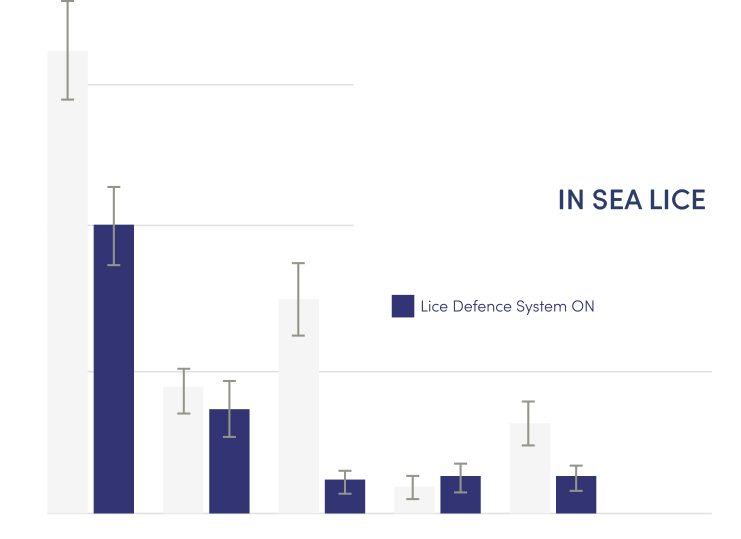
Six pens were equipped with the LiceDefence system. Each test period lasted two weeks, during which the system was activated in three pens while remaining deactivated in the other three.
At the end of each period, stationary sea lice (primarily those attached to the salmon during the trial) were counted and compared between the activated and deactivated groups. In the subsequent period, the activation status was switched between the groups to ensure balanced comparison.

Test 1:
TEST ONE COMPARED TO CONTROL GROUP

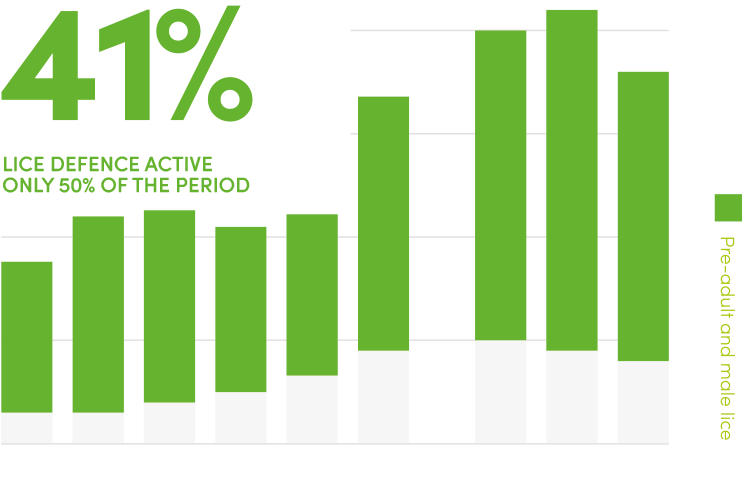
In test 2 three control pens with no system installed were compared to the lice count of the six pens in test 1. The pens in test 1 were equipped with the Lice Defence system but only active 50% of the time. The trial ran for approximately three months. The LiceDefence system acts preventively by eliminating sea lice before they attach to the salmon. Average stationary lice per salmon started at 0.75 at the trial’s outset (with these lice maturing during the period). In a scenario with no initial lice infection, the LiceDefence system could be expected to deliver even stronger preventive results.

WANT TO KNOW
MORE?

Let's talk


TOR HALDORSEN
tor@coastcorporate.com

Web design: Vido.is
Scroll to Top